
How to prioritize tasks when everything feels urgent
To prioritize tasks, list everything, remove what does not matter, sort the rest by deadline and impact, and commit to the top three for today. The Eisenhower matrix helps by separating urgent from important. Everything below the line waits, and waiting is a decision, not a failure.
Coming soon to iPhone
How do I prioritize tasks quickly?
Use this five-step pass. It takes about ten minutes.
- Write every open task on one list. Do not sort yet.
- Delete anything that no longer matters and anything someone else should do.
- Mark each remaining task with a deadline, or "none".
- Mark each with its impact: high if it moves your main goal or avoids a real penalty, low otherwise.
- Pick three tasks for today: the earliest high-impact deadline first.
What is the Eisenhower matrix?
The Eisenhower matrix sorts tasks into four boxes by urgency and importance. It is named after Dwight D. Eisenhower, who is quoted as saying that what is important is seldom urgent and what is urgent is seldom important (Wikipedia: Time management).
| Urgent | Not urgent | |
|---|---|---|
| Important | Do now (deadline today, a problem to fix) | Schedule (goal work, health, planning) |
| Not important | Delegate or shorten (most interruptions) | Delete (time wasters) |
How do I decide what is important?
Important means it moves your main goal, protects health or money, or keeps a relationship you value. If you cannot link a task to one of those, it is probably not important. Ask: what happens if I do not do this by Friday? If the answer is "nothing", it can wait.
The question that helps most is: which one task, if done, makes the rest easier? Start there.
What if everything really is urgent?
Sometimes the list is truly full. Try these in order.
- Ask the requester which of two deadlines matters more. Making them choose clarifies things quickly.
- Do the smallest version of each urgent task instead of the full version of one.
- Block 90 minutes for the single task with the biggest penalty and silence notifications.
- Negotiate the deadline on the lower-impact items now, not after you miss them.
- After the crunch, write down why everything was urgent and fix the cause.
How many priorities can I have in a day?
Three is a workable number. Ivy Lee's widely retold method had six tasks; the 1-3-5 rule uses one big, three medium and five small tasks. Both limit the list to what a day can hold. See the Ivy Lee method guide for details.
If you keep more than five open priorities, you have none.
How do I say no to the rest?
Say "not now" and give a date. "I can look at that on Thursday" is honest and keeps the relationship. Keep a someday list for ideas that are not dead but not active. Review it weekly, so nothing you promised is lost.
Saying no to a task protects yes to the main goal. Write down your main goal at the top of the list; it makes trade-offs easier to see.
What does a worked example look like?
A Monday list: send the invoice (deadline today), prepare a slide deck (deadline Thursday), book a dentist visit (no deadline), reply to 14 emails, learn a new spreadsheet function (no deadline, supports your goal), tidy the desk. Delete the desk. Delegate nothing. Mark impact: the invoice is high (money, today), the deck is high (Thursday), the function is medium (goal), the dentist is medium, emails are low.
Today's three: invoice, one hour on the deck, 15 minutes on the function. Emails go in a 20-minute block after lunch, and the dentist call is scheduled for Wednesday at 12:30. Nothing was dropped silently; every task has a date or a decision.
Which mistakes make prioritizing fail?
Watch for these patterns.
- Treating every email as a priority, which lets other people set your list.
- Starting with the easiest tasks for the feeling of progress and running out of time for the important one.
- Never revisiting the list, so yesterday's priority crowds out today's.
- Keeping deadlines only in your head. Write them next to the task.
- Adding new items without removing any.
How do I prioritize when two important tasks collide?
Compare the cost of delay. Which task gets worse faster if postponed by a day? A client waiting costs more each hour than a personal project, and a project with a fixed date costs more than one without. If costs are equal, pick the task that makes the other easier, or the one that frees up other people.
When you still cannot decide, set a ten-minute timer on one of them. Sometimes starting clarifies which one is really pressing.
How do I prioritize between goals, not just tasks?
Use the same logic: pick one main goal for the next 90 to 180 days. Other goals become supporting habits or go on a later list. People who run three major goals at once finish none on time. Review the choice at each monthly checkpoint.
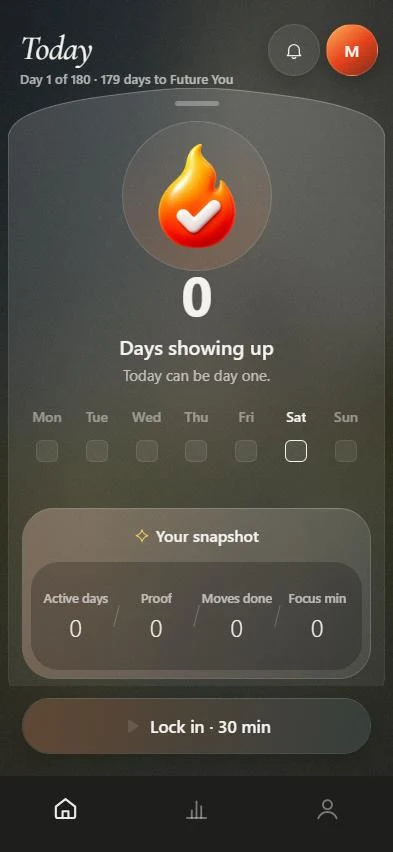
M6 puts this into the app. It shows three actions a day drawn from your route, each with a reason and a time, and you can move or skip an action and say why. Your own additions are marked as yours.
Frequently asked questions
How do I prioritize tasks at work?
Sort by deadline and impact, clarify with your manager which of two conflicting tasks wins, and commit to three tasks for the day.
What is the best method to prioritize tasks?
There is no single best. The Eisenhower matrix suits sorting; the 1-3-5 rule suits daily planning; the Ivy Lee method suits ordering.
How do I prioritize tasks with ADHD?
Keep the list very short, use visible timers and choose the first task by lowest friction. Consult a clinician for medical advice.
How do I prioritize when everything is urgent?
Ask which deadline matters most, do smaller versions of each task, and protect one focused block for the biggest penalty.
How often should I reprioritize?
Daily for the top three and weekly for the whole list.