
Weekly review questions: 12 to ask every week
A weekly review is a ten-minute check at the end of the week. Ask what you planned, what you did, what got in the way and what next week should look like: less, the same or more. Write short answers, then change one thing in the plan. The review is for adjusting the plan, not for judging yourself.
Coming soon to iPhone
What is a weekly review?
It is a fixed appointment with your own plan. You look back over seven days, look ahead over the next seven, and make one or two changes. David Allen's productivity method Getting Things Done made the weekly review a core habit: a regular pass over open commitments so nothing sits unattended.
For a personal goal the review can be much lighter than a full system. Ten minutes and a handful of questions are enough.
What are good weekly review questions?
Use these twelve in four groups. Answer each in one or two lines.
| Group | Question |
|---|---|
| Plan vs reality | What did I plan to do this week? |
| Plan vs reality | What did I actually do? |
| Plan vs reality | On how many of seven days did I show up? |
| Obstacles | What got in the way: time, energy, something unexpected, avoidance or nothing? |
| Obstacles | Which task did I move or skip most, and why? |
| Obstacles | What is one thing I can remove from next week? |
| Feeling | Was the week too much, about right or too easy? |
| Feeling | When did I feel best about the work? |
| Feeling | What did I avoid saying to anyone? |
| Next week | What is the one result that would make next week a win? |
| Next week | Should the load be less, the same or more? |
| Next week | What is the first task on Monday? |
How do I run the review in 10 minutes?
Set a repeating appointment at the same time each week. Sunday evening and Friday afternoon both work.
- Open your plan and last week's notes (1 minute).
- Count the days you showed up out of seven (1 minute).
- Answer the plan-versus-reality questions in two lines each (3 minutes).
- Name the main obstacle and one fix (2 minutes).
- Choose less, the same or more for next week (1 minute).
- Write the first task for Monday and close the notes (2 minutes).
What should I do with the answers?
Change one thing. If energy was the obstacle three weeks running, move the hard task earlier or lower the daily amount. If "too much" came up twice, cut the load by a quarter. If nothing got in the way and the week felt easy, raise the target slightly.
Do not add three fixes at once. You will not know which one worked.
A weekly review checklist
Tick these off if you prefer a checklist to questions.
- Calendar for the next two weeks checked for conflicts.
- Unfinished tasks moved, split or deleted.
- Main goal progress written as a number.
- One obstacle named, one fix chosen.
- Next week's load set: less, the same or more.
- Monday's first task written down.
What does a filled-in review look like?
Here is a sample for a person saving for a trip. Planned: log spending daily, move 100 to savings on Friday, cancel one subscription. Did: logged five days of seven, moved 100, did not cancel the subscription. Showed up: 5 of 7. Obstacle: forgot on the weekend. Feeling: about right. Next week: same load, add a Saturday phone reminder, cancel the subscription on Monday. First task Monday: open the subscription list.
The whole entry is under 70 words and took four minutes. That is the standard to aim for: short, honest and ending with a named first task.
What mistakes make weekly reviews fail?
Most reviews die from the same few habits.
- Making the review long, so it feels like a chore by week three.
- Using it to criticize yourself instead of to adjust the plan.
- Skipping the "what got in the way" question, which holds the most useful information.
- Changing everything at once, so the next review cannot tell what worked.
- Doing it at a different time every week, so it is easy to forget.
- Keeping answers in your head. Write one line per question.
Does the review differ for fitness, money or work goals?
The structure stays the same, only the numbers change. For a fitness goal, add sessions done and one body signal such as sleep or soreness. For a money goal, add the balance and the week's spending total. For a work goal, add the milestone status and the one decision you are waiting on.
Keep the numeric line at the top of the page so that in week twelve you can scan the trend in ten seconds.
What about a monthly review?
Add four questions on the same day as your fourth weekly review: Am I closer to the checkpoint? Is the date still realistic? Is the reason still true? What would I change if I restarted today? These catch slow drift that a single week hides. The 6-month goal plan shows where monthly checkpoints go.
How does M6 handle the weekly review?
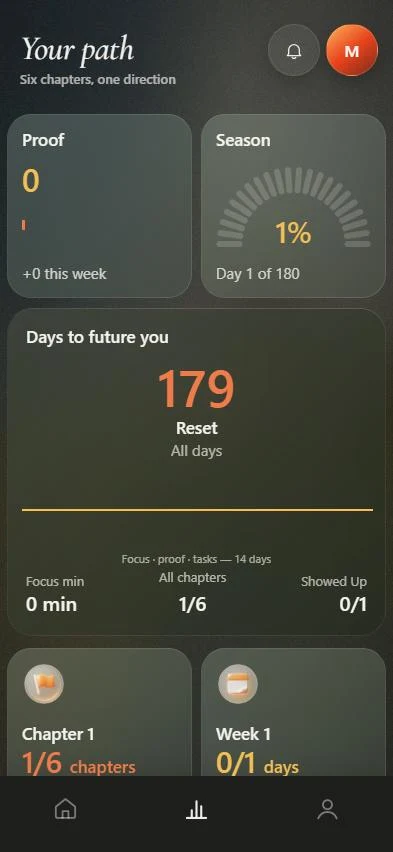
M6 shows what you planned, what you did, how many days you showed up out of seven and how long you were locked in. You answer three questions: how it felt, what got in the way and what next week should be. Then it shows what it changed in the plan. The full description is on the route page.
Frequently asked questions
What are the best weekly review questions?
Ask what you planned, what you did, what got in the way, how the week felt and whether next week should be less, the same or more.
How long should a weekly review take?
Ten minutes for a personal goal. Longer reviews tend to be skipped, so keep it short and regular.
When is the best time for a weekly review?
Choose the same slot every week. Friday afternoon closes the work week; Sunday evening sets up Monday.
What should I do if I miss a weekly review?
Do a shorter one the next day, or skip to the next slot. Do not try to review two weeks in detail.
Is a weekly review the same as a retrospective?
They are close. A retrospective is a team ritual in agile projects; a personal weekly review applies the same look-back-and-adjust idea to your own goal.