 M6
M66-month goal plan: how to build one that lasts
A 6-month goal plan takes one outcome you want in about 180 days, splits it into six monthly checkpoints, and breaks each month into a small daily routine. Write the outcome so you can check it with a number or a yes or no, then work backward from the end date and review every week.
Coming soon to iPhone
What is a 6-month goal plan?
It is a plan for one result with a date roughly 180 days away. Six months is long enough for real change and short enough that you can still picture the finish. Goal-setting research and practice, summarized on Wikipedia: Goal setting, agree on the basics: a goal needs to be clear, and it needs a way to check progress.
The most common checklist is the SMART criteria, an acronym for goals that are specific, measurable, assignable or achievable, realistic and time-bound. You do not need to memorize it. You need an outcome you can verify on a given date.
How do I make one, step by step?
Follow these steps in order. They take about an hour the first time.
- Write the outcome in one sentence, as if it already happened: "In six months I run 10 km without stopping."
- Add a number or a yes or no check, and a date 180 days from today.
- Write your starting point honestly. If you do not know a number, write "unknown" instead of guessing.
- Pick the one target that matters most. When the week gets crowded, it gets your time first.
- Split the route into six months and give each month one checkpoint you can verify.
- Decide how many minutes a day and how many days a week you will really give, and fix a rest day.
- Choose a daily routine of no more than three actions, with the smallest one doable on a bad day.
- Pick a weekly review slot. Ten minutes on the same day each week is enough.
What should each month contain?
Months are a way to pace the work. Here is one common shape. Adjust the content to your goal.
| Month | Purpose | Checkpoint example |
|---|---|---|
| 1 | Baseline and a routine you can keep | Starting numbers written, routine run on 20 of 30 days |
| 2 | Build volume slowly | First measurable gain over the baseline |
| 3 | Halfway review | Half of the target distance covered, plan adjusted |
| 4 | Work on the hardest part | The main obstacle has a tested fix |
| 5 | Raise the load | A full dress rehearsal of the end result |
| 6 | Finish and look back | Outcome checked on the date, next goal chosen |
What does a worked example look like?
Say the outcome is "run a 10K race by April 8". You start at 2 km, so the baseline is 2 km. The North Star is finishing the race. Month 3 is a 5 km run without stopping, month 5 is an 8 km run, and month 6 is race week.
The daily routine is three actions: a run or a stretch on training days, a 10-minute mobility block and a logged note. Rest day is Sunday. The weekly review asks one question: did the load feel too easy, good or too much?
Why do 6-month plans fail?
The planning fallacy is the main culprit. People predict how long their own tasks will take with an optimistic bias, even when similar tasks took longer in the past (Wikipedia: Planning fallacy). A plan that assumes every week goes perfectly breaks in week three.
Other common causes are too many goals at once, no slack for rest days and no rule for what to do after a missed day. Build slack in from the start and write the recovery rule in advance: after a gap, start from today and do not make up the missed days.
How do I turn the plan into daily action?
Use if-then planning. An implementation intention is a plan in the form "if situation X occurs, I will do Y", and research summarized on Wikipedia: Implementation intention links it to better goal attainment. For example: "If it is 7:30 on a weekday, I put on my running shoes."
Keep the daily list short. Three actions are enough to move a six-month goal. More than that and the list becomes a backlog you will not finish.
How do I pick the right goal?
Start from a vague wish and rewrite it until you could check it on the end date. The table shows common wishes and a version that a plan can use.
| Vague wish | Plan-ready version |
|---|---|
| Get fit | Run 10 km without stopping by April 8, starting from 2 km |
| Save money | Save $3,000 by April 8 at $500 a month |
| Learn Spanish | Hold a 10-minute conversation with a tutor on April 8 |
| Write a book | Finish a 40,000-word first draft by April 8 |
| Be more productive | Finish the one project that has been open since June |
What if I do not know my starting number?
Write "unknown" and measure it in the first week. A guessed baseline makes every later checkpoint look better or worse than it is. M6 follows the same rule: every field in its starting-point step is optional, an unknown number stays unknown, and the app never invents one for you.
The same goes for targets. You update the current value by hand when you measure it, and the history stays visible, so you can see the real curve instead of the planned one.
What does a weekly review ask?
Keep it to three questions and about ten minutes.
- What did I plan, and what did I finish?
- What got in the way: time, energy, something unexpected or procrastination?
- Should next week be lighter, the same or heavier?
How does M6 help with a 6-month plan?
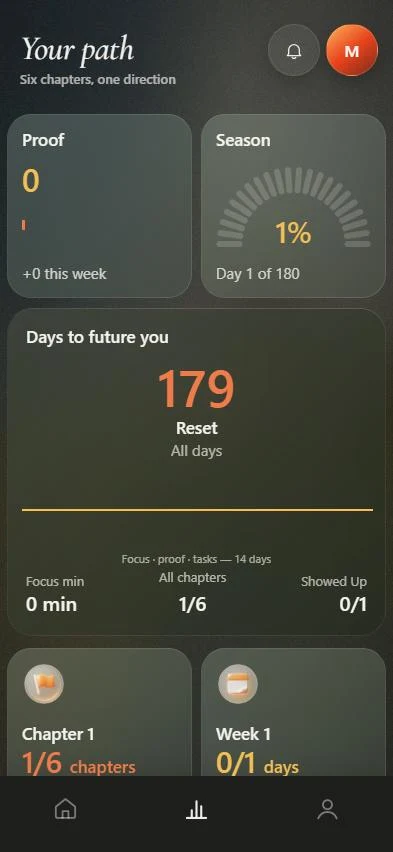
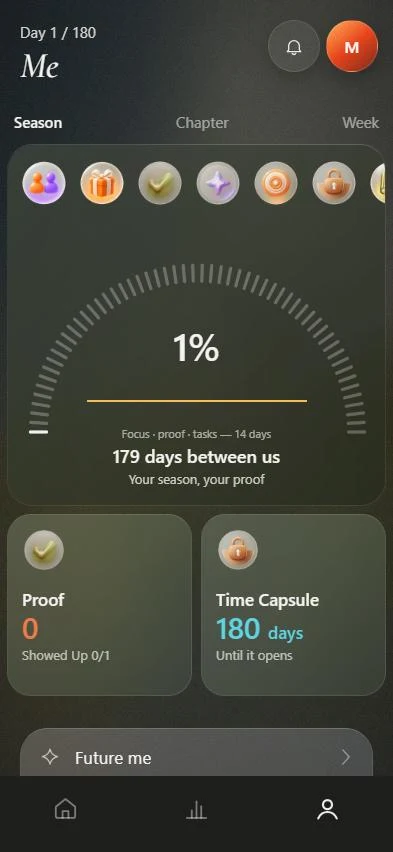
M6 does the structure for you. You describe the change, confirm targets, pick a North Star and set your time, and the app builds a 180-day route with six chapters and milestones. Each day shows three actions, and a weekly review rebuilds the next week.
If you prefer paper, the steps above work without any app. The approach is the same.
Frequently asked questions
How do I set 6-month goals?
Pick one outcome with a number or a yes or no check, set a date 180 days away, write your honest starting point, split the route into six monthly checkpoints and choose a daily routine of three actions or fewer.
How many goals should a 6-month plan have?
One main goal with at most two or three supporting targets. When everything is a priority, nothing is.
What should I do if I miss a week?
Do not try to make up the missed work. Restart from today, shrink the load for a few days and check whether the original plan was too heavy.
Is six months the right length?
It is a common choice because it fits real change and still feels close. A habit study cited on Wikipedia: Habit found that automaticity took 66 days on average, with a range of 18 to 254 days, so 180 days covers most of that range.
Do I need a template?
A page with the outcome, baseline, six checkpoints and a weekly review slot is enough. An app can hold the same structure and remind you.
How do I make a 6-month goal planner template?
Make one page with six rows, one per month, and four columns: purpose, checkpoint, weekly minutes and notes. Add the outcome and the end date at the top and a weekly review slot at the bottom.
Keep exploring
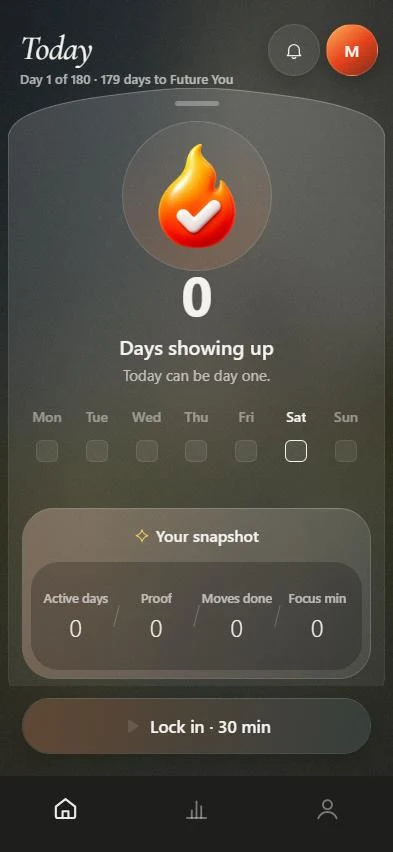 180-day challengeDaily minimum, checkpoints every 30 days and a weekly review.180-day routeSix chapters, milestones with dates, weekly review, rebuild after a gap.Three actions a dayThree actions with a reason and a time. Move, skip, add your own, rest.
 Accountability partnerWho to pick, how to run check-ins and what to share.