How to set goals and achieve them in 7 steps
To set a goal you can achieve, choose one outcome, write it so a stranger could check it, give it a date, then break it into a daily step small enough to do on a bad day. Review every week and change the plan when it fails. The goal stays; the route can move.
Coming soon to iPhone
What makes a goal one you can achieve?
A goal you can achieve has three properties: it is specific, it has a finish line you can check, and it is hard enough to matter. Goal-setting research summarized on Wikipedia: Goal-setting theory found that specific, difficult goals led to better performance than easy goals or vague instructions such as "do your best".
"Get healthier" fails the first test because nobody can tell when it is done. "Run 10 km without stopping by April 30" passes: it has a number and a date. The rest of this guide turns that kind of sentence into a daily routine.
How do I set a goal, step by step?
Do these in one sitting. It takes about 30 minutes, and you only need a notes app or paper.
- Pick one outcome. Not a theme, an outcome: a race finished, a draft written, a balance reached.
- Write it as a sentence with a number and a date: "Save 3,000 by March 31".
- Write the reason in one line. You will reread it in month three, when the reason matters more than the plan.
- Count backward from the date and mark a checkpoint every month.
- Choose the smallest daily action that still moves the goal. If you doubt you would do it on your worst day, make it smaller.
- Decide where and when the action happens, for example "after breakfast, at the kitchen table".
- Schedule a weekly review and put it in your calendar before you start.
How many goals should I work on at once?
One main goal, plus at most two small supporting habits. Attention is the limit, not ambition. People who list eight goals in January usually progress on the one that has a visible deadline and drop the rest by February.
If you have many wishes, rank them and park the others on a "later" list with a review date. Parking is a decision; it is not quitting.
How do I turn a goal into daily actions?
Work from the finish line backward. A goal of 3,000 saved in 180 days means roughly 17 a day or 117 a week, and the first checkpoint is a month away. Once you have those numbers, the daily action is a plain list of one to three items.
The table shows the same goal at three levels.
| Level | Example (save 3,000) | Check |
|---|---|---|
| Outcome | Savings balance reaches 3,000 on March 31 | Balance on the date |
| Monthly checkpoint | About 500 added per month | Balance on the 1st |
| Weekly target | About 117 moved to savings every Friday | Transfer done: yes or no |
| Daily action | Log today's spending, 5 minutes | Entry exists |
Where should the plan live?
Anywhere you will look at every morning. A paper card on the desk works. So does a note pinned in your phone. What matters is that the three things are visible together: the goal sentence, today's action and the date of the next checkpoint.
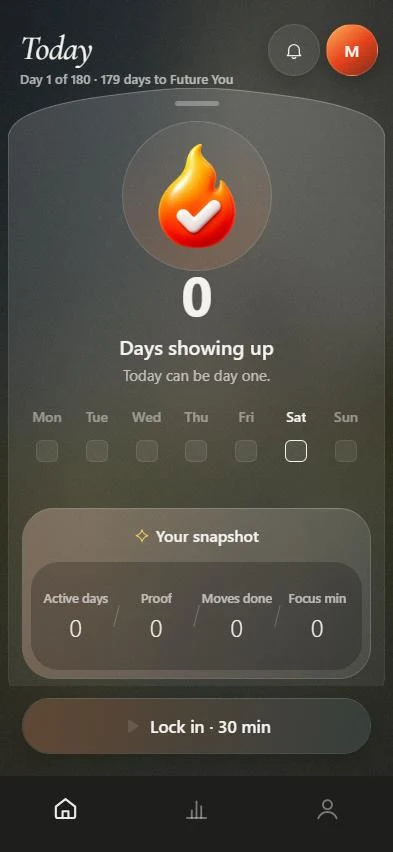
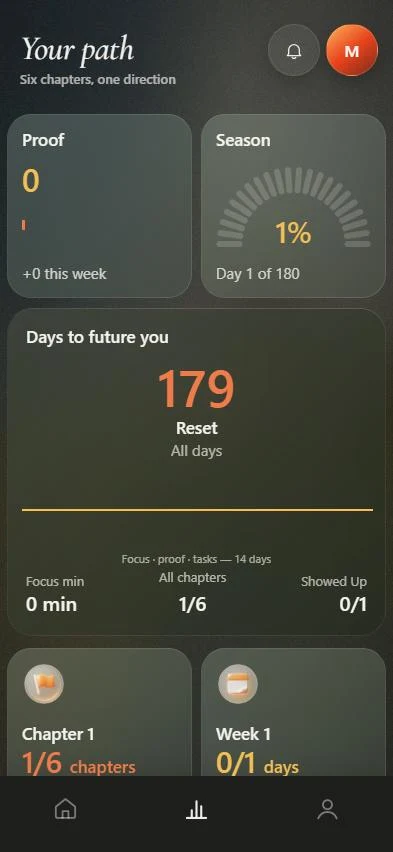
If you prefer an app, M6 builds a 180-day route of six chapters from one goal and shows three actions a day. It stores your goals and notes on the device and does not need an account.
How do I review progress?
Once a week, ten minutes. Compare what you planned with what you did, find one obstacle, and decide next week's plan: less, the same or more. The weekly review questions guide has a full list. Skip the guilt step; the review is for adjusting the plan.
Once a month, check the checkpoint. If you are behind by more than a week of work, either extend the daily time or move the date. Both are legitimate. Pretending nothing changed is not.
What does a worked example look like?
Take the goal "Finish a 10 km run in under 65 minutes by April 30". The reason: "I want to be someone who finishes things I start." Checkpoints: run 3 km continuously by the end of month one, 5 km by month two, 7 km by month three, and a full 10 km training run by the start of month five.
The daily action is a 25-minute easy run or walk-run on four days, with a 10-minute mobility routine on the others. The weekly review asks whether the four sessions happened and how the legs felt. If knees complain in week six, the plan drops one session and adds a rest day, and the date stays.
How do I keep going after the first two weeks?
Motivation is highest at the start and lowest in the middle, so build support before you need it. Put the next checkpoint date where you can see it. Keep a visible record of what you have done, whether it is ticks on a card or a list of finished actions. On a day you feel you have achieved nothing, reading the record is the quickest cure.
Also decide in advance what you will do on a hard day. "Ten minutes, then stop" is a plan. "Try harder" is not.
What stops people from achieving goals?
Most failures come from the same few causes. Spot them early.
- The goal has no number, so progress is a feeling.
- The daily action is too big for a bad day, so one bad day becomes three.
- There is no review, so a wrong plan runs for months.
- The reason is borrowed from other people and fades in week three.
- Too many goals compete for the same hour.
What if I fall off the plan?
Restart from today without catching up. A missed week is information about the plan, not a verdict on you. Shrink the daily action, keep the date if it is still realistic, and move on. The guide to getting back on track covers the first 48 hours.
Telling someone helps too. See how to choose an accountability partner if you want a person checking in.
Change the plan, not the goal.
Frequently asked questions
What is the best way to set goals?
Write one outcome with a number and a date, break it into monthly checkpoints, and choose a daily action small enough to do on your worst day. Review weekly.
How do I set goals and actually achieve them?
Reduce the goal to a daily action, decide when and where it happens, and review every week. Most goals fail from lack of review, not lack of effort.
How long should a goal take?
Three to six months suits most personal goals. It is long enough for a real change and short enough to plan in one piece. See the 6-month goal plan.
Should I share my goals with other people?
Share them with one person who will ask a plain question each week. Announcing goals widely adds pressure without adding support.
What if my goal is too big?
Cut it to the first visible result, such as the first 10 percent, and set a date for that. Then set the next one.