What to do when you lose motivation on a long goal
When you lose motivation, do not wait for it to return. Shrink the daily step to the smallest version, reread why you started, check whether the plan itself has become too heavy, and look at proof of what you already did. Motivation follows action more often than it leads it.
Coming soon to iPhone
Is losing motivation normal?
Yes. On any goal longer than a month you will have stretches where you do not feel like working. Motivation is a state that rises and falls with sleep, stress, novelty and visible progress. Treating it as a permanent trait leads to the conclusion "I am not a disciplined person", which is rarely accurate.
The more useful question is practical: what do I do on the days the feeling is gone? A plan that only works when you feel motivated is a plan for the first two weeks.
What should I do first?
Start with the cheapest steps. They take ten minutes together.
- Do the smallest version of today's action. Five minutes counts.
- Reread the reason you wrote when you started. If you did not write one, write one now in a single line.
- Look at proof: a list of finished actions, a log, photos. Evidence of past effort beats a pep talk.
- Check sleep, food and stress. Low energy mimics low motivation.
- Tell one person you are in a slump and what you will do tomorrow.
How do I tell a slump from a wrong goal?
Ask two questions. First: if I could finish this goal tomorrow for free, would I take it? If yes, the goal is still yours and you are tired. If the answer is a shrug, the goal may have changed. Second: is the resistance to the goal or to the plan? A route that asks for one hour a day when your life allows 25 minutes will produce resistance even for a goal you love.
Fix the plan first. Only after the plan is realistic should you consider dropping the goal, and then do it on purpose, with a note on why.
Which tactics work for which kind of slump?
Pick the row that matches how you feel.
| What it feels like | Likely cause | Try this |
|---|---|---|
| Tired, flat, no energy | Sleep or overload | Cut the load by a quarter for a week |
| Bored with the routine | No novelty, no visible progress | Change place or time; set a mini-checkpoint |
| Anxious about falling behind | Plan too ambitious | Move the date or shrink the target |
| Cannot see the point | Reason has faded | Rewrite the reason; read your proof |
| Doubt that it is working | No measurement | Record one number weekly |
How do I make progress visible?
Visible progress is the strongest low-cost motivator. Keep a record that grows: a tally of finished actions, a chart of the main number, a folder of before and after photos. A streak breaks on one bad day, while a record only grows, so prefer a count to a chain.
Albert Bandura proposed that personal experiences of success are the strongest source of self-efficacy, the belief that you can do what is needed (Wikipedia: Self-efficacy). A list of things you did is a mastery experience on demand.
What if I have missed several days?
Restart from today and do not make up the days. Make the first return day easy, a five-minute version, and write down what caused the gap. The get-back-on-track guide has a 48-hour plan.
What should I change in the plan?
A slump is data about the plan. Common adjustments:
- Lower the daily minimum, keep the habit of showing up.
- Add a rest day so effort has a rhythm.
- Move the hardest task to the time of day when you have the most energy.
- Add a checkpoint in two weeks, close enough to feel reachable.
- Add one person who asks about it weekly.
What does a 10-minute reset look like?
Set a timer for ten minutes and do these in order. Minutes 1 to 3: write what you have done in the last two weeks, even small items. Minutes 4 to 5: write why you started in one sentence. Minutes 6 to 8: pick one action for today that takes five minutes and a time to do it. Minutes 9 to 10: delete or postpone one thing that is not essential this week.
The aim is to turn a vague feeling of failure into three concrete facts: what I did, why I started, what I will do next. A vague problem stays heavy, while a specific one can be handled.
What helps in the middle of a six-month goal?
The middle is the hardest stretch because the start is gone and the end is far. Split the goal into chapters, with a named purpose for each month, so you are always working on a short stage. Add a small celebration at each checkpoint that is not food or spending, such as a day with no tasks or a walk with a friend.
Also plan a "reset week" around the halfway point with a lighter load and a longer weekly review. Use it to ask whether the route still fits your life. Changing a route is normal; hiding a problem is not.
When should I get outside help?
Low motivation that lasts for weeks, comes with changes in sleep or appetite, or makes ordinary tasks feel impossible can be a sign of something beyond a planning problem. In that case, talk to a doctor or a mental health professional. A goal planner is not a treatment.
How does M6 deal with a slump?
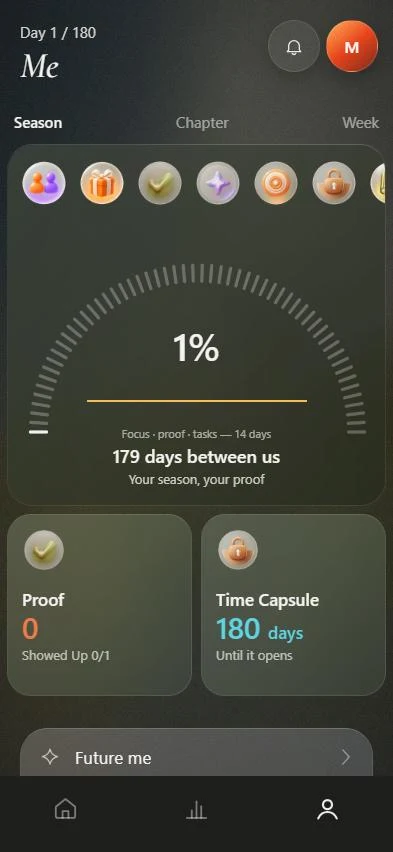
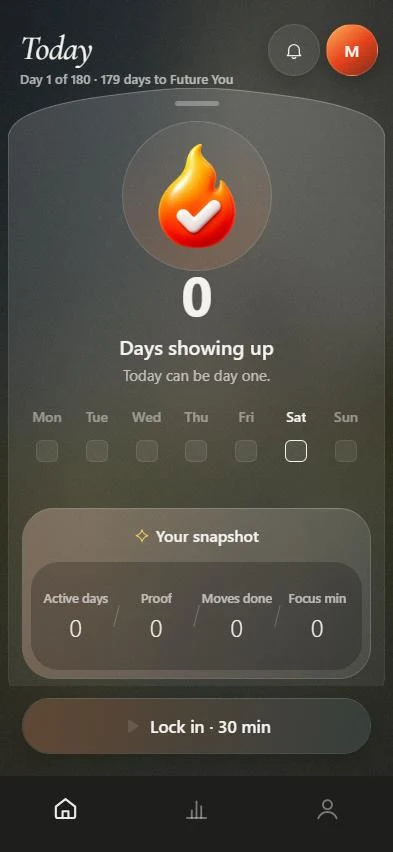
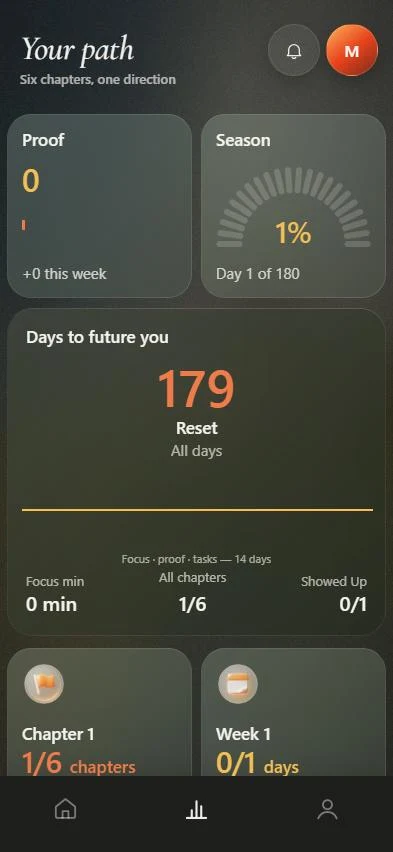
M6 treats skipped actions as information: when you skip, it asks what got in the way, and the weekly review uses your answers to rebuild the next week. After missed days it shows a short diff and says "No catching up. Start from today." The route and your proof stay. See the route page and the proof library.
Frequently asked questions
What to do when you lose motivation for everything?
Do very small actions, protect sleep, and tell one person. If low mood lasts for weeks or affects daily life, speak to a doctor or a mental health professional.
How do I stay motivated to reach my goals?
Rely on a small daily minimum, visible progress and a weekly review instead of on feeling motivated.
Why do I lose motivation after a few weeks?
Novelty fades and results are still far away. Add mini-checkpoints and a record of finished work to bridge the middle.
Should I quit if I lose motivation?
Not yet. Shrink the plan first. Quit on purpose only if the goal no longer matters to you.
Does motivation come before action?
Often it follows action. Starting for five minutes tends to produce the feeling, rather than waiting for the feeling to start.