 M6
M6Letter to your future self: template, prompts and examples
A letter to your future self is a message you write now and read on a set date. Write it in six steps: pick the open date, describe today, state what you want to be different, name your reasons, ask your future self three questions and seal it. Use specific details and keep it under one page.
Coming soon to iPhone
What is a letter to your future self?
It is a short message addressed to a later version of you, written with a date to open it. It works like a personal time capsule. A time capsule is, in general, a cache of items or information deliberately kept for communication with future people, and your letter is the smallest version of that idea.
The letter does two jobs. When you write it, it makes you put your plans into words. When you read it, it shows how much you remembered, forgot or changed.
How do I write one?
This template fits on one page and takes about 20 minutes.
- Pick the date it opens. Six months is a good first choice, because you remember the start and still have room to change.
- Describe today in three or four sentences: where you are, what a normal day is like, what is bothering you.
- State what you want to be different on the open date, in concrete terms.
- Write your reasons for starting, in your own words, without polishing them.
- Ask your future self three questions that they can answer with facts.
- Seal it where you cannot easily edit it, and set a reminder for the date.
What should I write about?
If you freeze, use these prompts. Pick four or five.
| Topic | Prompt |
|---|---|
| Today | What does an ordinary day look like right now? |
| Worries | What am I afraid will not change? |
| Goal | What do I want to be true on the open date? |
| Reasons | Why does this matter to me now? |
| Promise | What am I committing to do every week? |
| People | Who is helping me, and who should I thank? |
| Advice | What would I say to someone starting where I am? |
| Questions | Did I do it? What got in the way? What surprised me? |
| Money or health | What number would I like to see, and where is it today? |
| Small joys | What am I enjoying right now that I might forget? |
| Doubts | What would make me quit, and what should I do then? |
| A line to keep | What is one sentence I want to hear back? |
What does a short example look like?
Here is a short example you can copy and change. "Dear me on October 10. Today you are tired on weekdays and you skip the gym three times out of five. You want to run a 10 km race by April. Your reason: you want to trust yourself when you say you will do something. Questions for you: did you run three times a week? What got in the way? What would you change for the next six months? Be kind to the person who wrote this."
Notice the specifics: a day pattern, a number and questions with factual answers. Vague letters ("I hope you are happy") are pleasant to write and hard to learn from.
What mistakes should I avoid?
- Writing to a perfect future person. Write to a real one who may still be tired.
- Leaving out numbers. Without them you cannot tell what changed.
- Setting the date too far away. A year is long, and the details fade.
- Keeping it editable. If you can rewrite it, you will.
- Making it a to-do list. A letter is a record of intent, not a task list.
How far ahead should I write?
The right interval depends on what you want from the letter. This table gives common choices.
| Interval | Good for | What to expect |
|---|---|---|
| 3 months | A short project or a new habit | You will remember almost everything |
| 6 months | A personal goal with a start and a finish | A real difference, with the start still vivid |
| 1 year | A new job, a move, a school year | Many details will surprise you |
| 5 years | Big life plans | You will read it as a stranger reads a diary |
| 10 years | A milestone such as graduation | It becomes a keepsake |
What kinds of letters work well?
- A goal letter: the outcome, the reason and a few factual questions.
- A new-chapter letter: written before a move, a job or a degree, about what you hope to keep.
- A hard-days letter: written while things are fine, to be opened when you want to quit. Say what you were proud of and why you started.
- A gratitude letter: the people and small things you do not want to forget.
What should I do when I open it?
Read it once without judging. Then answer your own questions in writing, with facts. Compare what you wanted with what happened and write down one thing to keep and one to change.
If you did not reach the goal, treat the letter as data. It shows what you thought would be easy and what turned out harder than expected.
Paper or digital?
Paper feels more personal, and it can sit in a drawer for months. The risk is losing it or opening it early. A digital letter can be sealed by an app or an email scheduler, and the date is enforced.
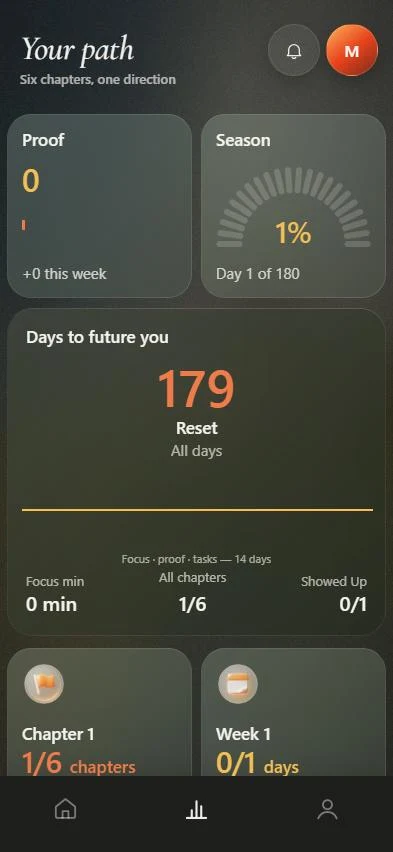
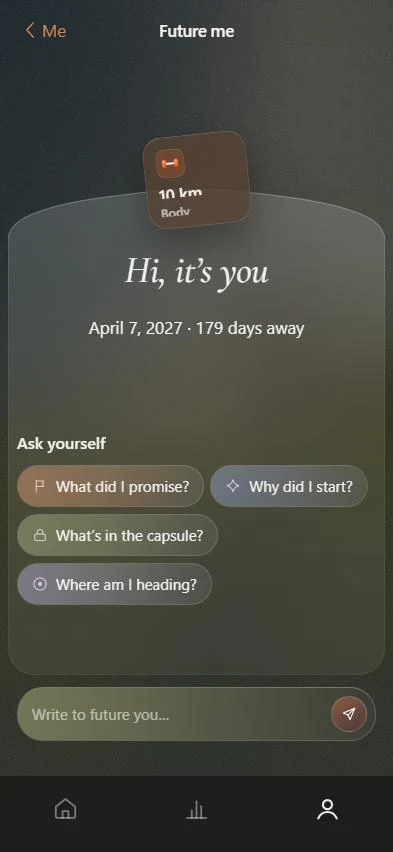
In M6 the time capsule is built for this. You write or record a message on day one, it stays sealed until day 180, and you can add lines later without opening the original. The capsule stays on your device and has no switch to share it.
Frequently asked questions
How long should a letter to my future self be?
One page is enough, roughly 250 to 400 words. Short letters get finished and read.
When should I open it?
Six months is a good first interval for a goal. For life events, a year or more is common. Pick a date and write it on the letter.
Can I add to the letter later?
You can write follow-up notes. M6 allows adding lines to a capsule while the original stays sealed.
Should I write by hand?
Either works. Handwriting slows you down and can make you think more, while typing is faster and easier to seal.
Is a letter to my future self the same as a journal?
No. A journal records the present for yourself, and a letter has a reader on a fixed future date and usually asks questions to be answered.