Personal goals examples: 30 ideas for every area of life
Good personal goals are specific, matter to you and have a measurable version. This guide gives 30 examples across health, money, career, learning, relationships and mind, with a way to turn each into a number and a date. Choose one for the next three to six months.
Coming soon to iPhone
What are good personal goals?
A good personal goal is something you want, not something you think you should want. It has one measurable result and a date. It sits in a life area that you can name, such as body, money, skills or relationships.
Start with an area that is bothering you now. A goal that fixes a daily frustration is easier to sustain than one that sounds impressive.
Personal goal examples for health and body
Pick behaviors you can count.
- Walk 8,000 steps on five days a week for three months.
- Sleep seven hours on five nights a week.
- Run a 5 km race by a set date.
- Cook at home five evenings a week.
- Book the dental checkup and the annual health visit.
Personal goal examples for money
Money goals work best when they name an amount and a date.
- Save a three-month emergency fund by the end of the year.
- Track every expense for 90 days.
- Cancel or renegotiate three recurring costs this month.
- Pay off one debt by a set date.
- Open a second income line and earn the first payment.
Personal goal examples for career and skills
Choose output you can show to another person.
- Finish a course and submit the final project.
- Publish a portfolio page with three projects.
- Apply to 30 roles and attend six interviews.
- Hold 10 coffee chats with people in the field you want.
- Learn 1,000 words in a new language.
Personal goal examples for learning, mind and relationships
These areas are harder to measure, so use frequency.
- Read 12 books in a year, about 15 pages a day.
- Meditate 10 minutes on 60 days out of 90.
- Write in a journal three times a week.
- Call one friend or relative each week.
- Host a dinner once a month.
- Take one day a week with no social media.
- Write a letter to your future self and set a date to open it.
How do I choose one goal from 30?
Use a short filter. Score each candidate from 1 to 5 on three questions and pick the highest total.
| Question | What a 5 means |
|---|---|
| Do I want this? | I would still want it if nobody knew |
| Can I control it? | Mostly my actions decide the result |
| Does the timing fit? | I have the hours and energy in the next 3 to 6 months |
How do I make a personal goal measurable?
Ask: how would a stranger check that I did it? Convert "be healthier" into steps, nights of sleep or a lab result. Convert "learn Spanish" into lessons done or minutes spoken. If you cannot find a number, use frequency: "four times a week for 12 weeks".
The SMART goals guide shows a five-part check you can run on any goal in this list.
What does a personal goal look like in full?
A full example: "Read 12 books by December 31, 15 pages a day, after dinner, tracked on a card on the fridge." Reason: "I want my evenings to be quiet and mine." Checkpoints: 3 books by March 31, 6 by June 30, 9 by September 30. Weekly review on Sunday: pages read, obstacle, next week.
Another: "Save 3,000 by March 31 by moving 115 to savings each Friday." Reason: "I want a buffer I do not worry about." Daily action: log spending in five minutes. Notice that both goals have a number, a date, a reason and a small repeatable action. That is the whole template.
What if I do not know what I want?
Start with the answer to "what annoys me most in my life right now?" Frustrations are clearer than desires. Pick one and phrase the opposite as a goal. A messy flat becomes "three rooms decluttered". Money anxiety becomes "a one-month buffer". Constant tiredness becomes "seven hours of sleep on five nights".
You can also run a two-week experiment: try three small candidate goals for five days each and see which one you want to continue. Wanting appears in practice more reliably than in thinking.
Should personal goals be big or small?
Make them hard enough to matter and small enough to start tomorrow. Research on goal-setting summarized on Wikipedia reports that difficult, specific goals outperform easy ones, provided you accept the goal and have the means to pursue it. The way to combine ambition with ease is a big outcome and a very small daily action. Run 10 km, and start with a 20-minute walk-run.
How do I avoid copying other people's goals?
Check where the goal came from. If you picked it because friends or social media do it, test it with the question: would I still want this if no one ever saw it? Goals based on your own reasons last longer than goals based on comparison. Write the reason in one line and keep it with the goal.
How do I keep a personal goal going?
Break it into a daily action, review weekly and keep proof of what you did. A personal goal has no boss, so build the structure yourself. Many people also pick one person to tell. The accountability partner guide covers how.
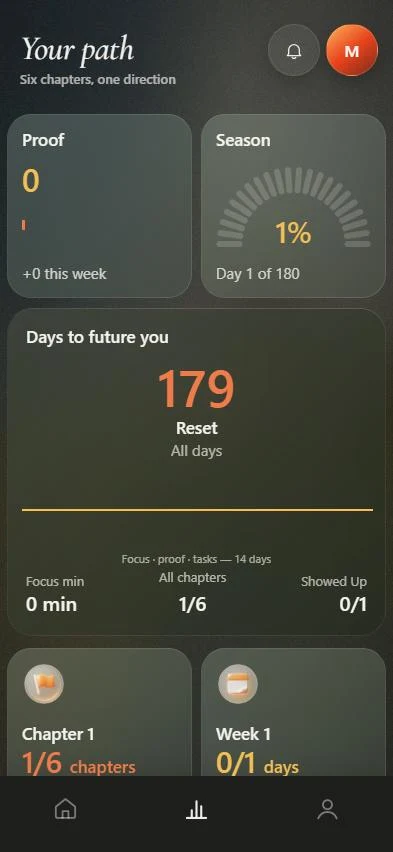
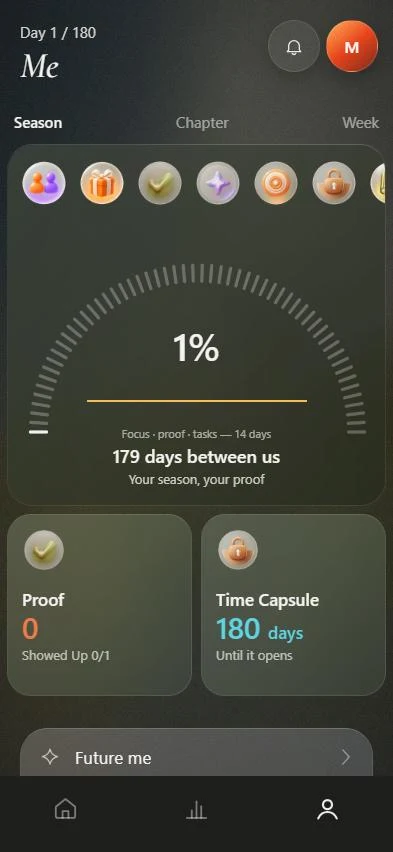
M6 is built around one personal goal. You choose a category (Money, Business, Body, Skills, Mind, Relationships, Lifestyle or Career), and it builds a 180-day route and gives three actions a day.
Frequently asked questions
What are some good personal goals?
Examples include saving a fixed amount, walking a daily step target, finishing a course, reading a book a month or calling a friend weekly.
How many personal goals should I have?
One main goal at a time, with at most two small supporting habits.
What are personal goals for work?
Examples are finishing a certification, leading a project, building a portfolio or having regular coffee chats with colleagues in other teams.
How do I write a personal goal?
Write one sentence with a result, a number and a date, then add a reason and a daily action.
How long should a personal goal take?
Three to six months suits most personal goals. Longer goals can be split into seasons.