
How to finish what you start: a practical method
You finish what you start by defining "done" before you begin, cutting the scope until it fits the time you have, and working a small fixed amount every day. Most projects stall in the middle, when novelty fades and the end is still far away. A written finish line and a daily minimum get you through that stretch.
Coming soon to iPhone
Why do I start things and not finish them?
Starting is rewarded by novelty. The middle is not. Somewhere between 30 and 80 percent of a project the early excitement is gone, the end is not in sight and every other idea looks easier. That is a normal pattern, not a character flaw.
Researchers describe a related effect named after Bluma Zeigarnik, who reported in the 1920s that interrupted tasks stay on the mind more than completed ones (Wikipedia: Zeigarnik effect). The effect has mixed replication results, but the everyday version rings true: open loops are tiring. Closing one is a relief, and you can plan for it.
How do I define "done" before I start?
Write one sentence that a stranger could use to check the result. "Finish the novel" is vague. "A 60,000-word draft saved as a single file" is checkable. For a course it might be "all 24 lessons watched and the final project submitted".
Add what is out of scope. If the draft is the goal, editing is not part of this round. A done definition with a clear edge prevents the project from growing a week before the finish.
What is the step-by-step method?
Use this as a checklist when you open a project or when one has stalled.
- Write the done sentence and the due date at the top of the page.
- List everything left. Count the items. A number is easier to fight than a feeling.
- Cut the list. Remove anything that does not change the done sentence, and mark it "next round".
- Choose a daily minimum: the amount you would do on a bad day, such as 20 minutes or 300 words.
- Work the minimum every day at the same time, and record it in one line.
- At the halfway date, compare the remaining list with the remaining days. Cut again if needed.
How small should the daily minimum be?
Small enough that skipping it feels silly. If the minimum is "write 2,000 words", a tired Wednesday will beat you. If it is "write 200 words", you will usually write more once you sit down, and on the worst day you still keep the chain.
A good test: would you do it with a fever and a deadline elsewhere? If not, halve it. You can always do extra, and extra never counts as the plan.
What do I do in the middle slump?
Expect it, and plan a response in advance. These tactics work for most projects.
- Switch to the easiest remaining item for one day. Momentum matters more than order.
- Change the place or the hour, not the amount.
- Show the unfinished work to one person and give them a date.
- Re-read your reason for starting. Write a new one-line version if it has changed.
- Count days left out loud. Seeing 41 days remaining is concrete; "soon" is not.
What does this look like for a real project?
Say you bought an online course with 24 lessons and stopped at lesson 9. The done sentence: "All 24 lessons watched and the final exercise submitted by December 20". Remaining: 15 lessons plus the exercise, 16 items. Cut: the optional reading list goes to "next round". With 66 days left, the daily minimum is one lesson, about 25 minutes, five days a week.
That plan needs about 16 working days, which leaves a large buffer. A buffer matters, because the real plan will be interrupted. Compare the two versions: "finish the course sometime" has no end, while the plan above has a visible end in under four weeks of actual work.
Which reasons for stalling need which fix?
The fix depends on why you stopped. The table matches common causes to a first response.
| Cause | How it shows up | First fix |
|---|---|---|
| Scope too big | List keeps growing | Cut to the done sentence |
| Unclear next step | You open the file and close it | Write the next 10-minute task |
| Perfectionism | You rewrite what is already fine | Set a "good enough" rule and a deadline |
| Boredom | Every other task looks better | Do the easiest item for a day, then return |
| Fatigue or overload | You skip days in clusters | Lower the minimum and add a rest day |
| Lost reason | You cannot say why you started | Rewrite the reason or end the project on purpose |
What if I am a perfectionist?
Perfectionists often stall at 90 percent, because finishing means exposing the work to judgment. Set a "good enough" standard before you begin, in writing, such as "the draft needs to be readable, not good". Give the finished version a date to be shown to one person. A shipped, imperfect result teaches you more than a polished one that stays in a folder.
Should I stop some projects?
Yes, deliberately. Quitting with a decision is different from drifting away. If you stop, write one line: what you learned and why you stopped. Then take it off the active list so it stops taking attention.
The rule many people use: no more than one active major project at a time, and a review date for anything on pause. Everything else waits.
How can an app help me finish?
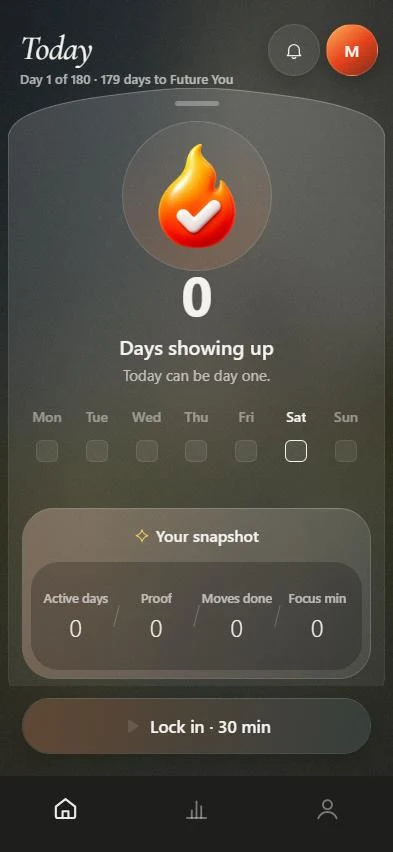
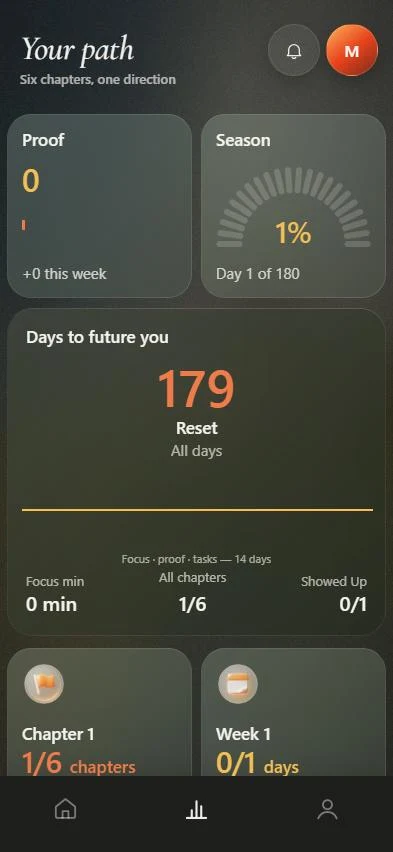
An app helps if it keeps the end visible and the daily step small. M6 shows a day counter, for example Day 1 of 180, and three actions a day. Finished actions are saved as proof, so the work you have done stays in view during a slump. If you miss days, it rebuilds the route from today and keeps the goal.
You can do the same on paper. The point is the done sentence, the date and the minimum, not the tool.
Frequently asked questions
Why can I not finish anything I start?
Usually the scope is too large, the finish line is vague or the daily amount is too heavy for ordinary days. Define done, cut scope and set a small daily minimum.
How do I stay motivated to finish a project?
Do not rely on motivation. Use a fixed daily minimum, a visible day count and one person who knows your due date.
Is it bad to quit a project?
No, if you decide on purpose and write down why. Drifting away is what costs you, because the project keeps occupying your head.
How long should a project take to be finished?
Aim for a finish line within 90 to 180 days. Longer projects should be split into seasons with their own done sentences.
What if I lose interest halfway?
Treat it as the expected middle slump. Do the easiest remaining item, keep the minimum and reread your reason before deciding to quit.
Keep exploring
How to Stop Procrastinating and Get Things DoneFind the blocker, shrink the first step to five minutes, remove friction, start at a fixed time.180-day challengeDaily minimum, checkpoints every 30 days and a weekly review.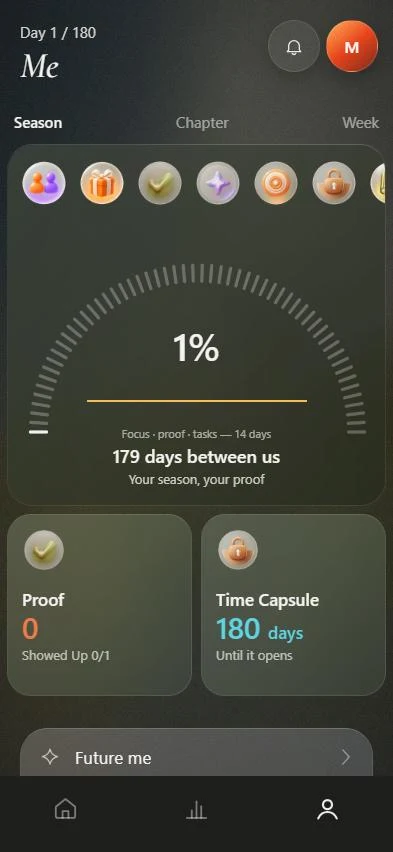 ProofA library of finished actions, focus sessions and milestones.
 What to Do When You Lose Motivation on a Long GoalShrink the step, reread your reason, check the plan, read your proof. A checklist for the slump.