
How to stop procrastinating and get things done
To stop procrastinating, find what exactly you are avoiding, then shrink the first step until it takes five minutes or less and start it at a fixed time. Most delay comes from an unclear next step, a task that feels too big, or discomfort with the result. Fix the cause and the delay shrinks.
Coming soon to iPhone
Why do I procrastinate?
Procrastination is described as voluntarily delaying an intended action even though you expect to be worse off for the delay. It is not a time-management failure alone. It is often a way of avoiding a feeling: boredom, anxiety, fear of a poor result, or confusion about where to start.
That matters because the fix depends on the feeling. A task you dread needs a smaller first step. A task you do not understand needs a clearer next action. A task that does not matter to you may need to be dropped.
What are you actually avoiding?
Ask yourself three questions about the task you keep postponing.
- Is the next step unclear? If you cannot say what you would physically do first, the task is not ready.
- Is it too big? A task that takes more than an hour on a normal day often hides several tasks.
- Is it uncomfortable? Fear of judgment, boredom and the chance of failing all push tasks to tomorrow.
- Does it matter? If the honest answer is no, delete it or delegate it.
What is the 5-minute start?
Agree with yourself to work for five minutes and allow yourself to stop afterward. This works because the hardest part of a dreaded task is the first minute. Once you start, continuing costs less than stopping and restarting.
Make the five minutes concrete: "Open the document and write the first heading", "Put on running shoes and walk out the door", "List the three documents I need". You can stop at five minutes with no penalty, but most days you will not want to.
How do I set it up, step by step?
Use this sequence the next time you notice yourself avoiding something.
- Write the task as a verb and a result: "Draft the first paragraph of the report".
- Write the first five-minute action on its own line.
- Remove one source of friction: close extra tabs, put the phone in another room, lay out what you need.
- Decide the time and place: "9:30, at the desk".
- Start a timer for the block. A focus timer tied to the task works well.
- When the block ends, write one line about what is left and stop or continue.
How does a fixed start time help?
Deciding when to start takes the decision out of the moment. Psychologist Peter Gollwitzer described this as an implementation intention: an if-then plan such as "If it is 9:30, then I open the report" (Wikipedia: Implementation intention). Studies of such plans report better follow-through than goals alone.
Pick a cue that already happens every day, such as finishing coffee, and attach the start to it. The cue replaces the internal debate.
Which techniques fit which type of procrastination?
No single trick works for everyone. This table matches the cause to a technique.
| Cause | Technique | Example |
|---|---|---|
| Unclear next step | Write the physical first action | "Open the budget sheet and list income" |
| Task too big | Slice into 25-minute pieces | One focus block per section |
| Fear of a poor result | Allow a rough first version | "Write the worst possible draft" |
| Boredom | Pair with something pleasant | Do the task at a cafe |
| Too many options | Choose three tasks for the day | The 1-3-5 rule |
| Low energy | Do the smallest task first | Ten-minute version only |
How do I keep it from coming back?
Procrastination returns when the plan is too heavy. Set a daily minimum small enough to survive a bad day, record that you did it, and review weekly. The weekly review questions include one that catches avoided tasks early: which task did I move or skip most, and why?
Also keep the daily list short. Three to five tasks that you finish teach your brain that starting is safe.
What does the 5-minute start look like in practice?
Say you keep postponing a tax form. The unclear version is "do taxes". The workable version: "Find the login for the tax portal and put the password reminder in the notes app", five minutes, at 9:30 after coffee. Often the next step ("download last year's return") follows naturally. If it does not, you have still moved the task forward, and tomorrow's first step is already written.
Say you avoid a presentation. The first step is "write three bullet points of what the audience should remember". Nothing is polished, nothing is shown, and you cannot fail at three bullets.
What should I do when I am procrastinating on purpose?
Sometimes you delay because the task truly should not be done now. Check by asking: if this vanished, would I be relieved or worried? Relief means the task is not important and should be removed. Worry means it matters, and the delay is avoidance. Treat the second case with the steps above and the first with a delete key.
Also watch for productive procrastination: cleaning the kitchen to avoid the report. It feels virtuous. Name it when it happens: "I am avoiding the report", then do the five-minute start.
Can an app help me stop procrastinating?
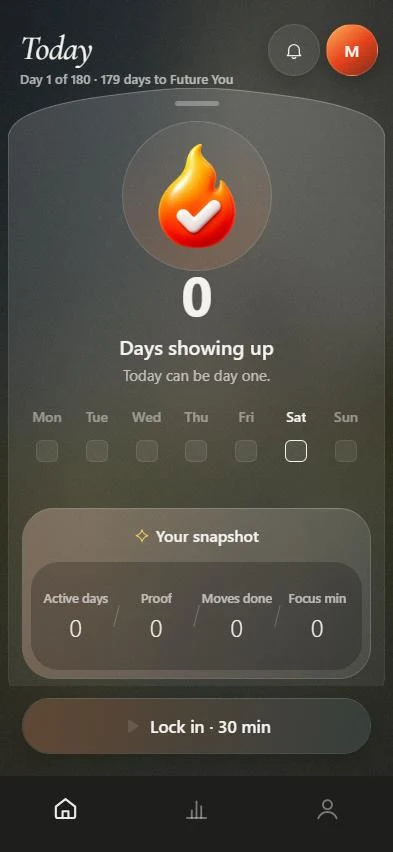
It can make the first step smaller and the list shorter, but it cannot do the work. M6 shows three actions a day with a reason and a time for each, and the Lock In screen starts a block on one action with the line "Stay here." Lock In does not block other apps. If you need a hard barrier, iOS Focus and Screen Time are the right tools.
Frequently asked questions
How do I stop procrastinating right now?
Pick the task, write its first five-minute action and start a timer. Allow yourself to stop when it rings. Starting is the hard part.
Is procrastination laziness?
Not usually. It is often avoidance of an unpleasant feeling or confusion about the first step, and people who procrastinate often work hard on other tasks.
How do I stop procrastinating with ADHD?
Many of the same tactics apply, with more external structure: visible timers, very small first steps and a fixed start cue. Speak with a clinician for treatment advice.
What is the best app to stop procrastinating?
Choose one that keeps the list short and makes starting easy. See the best goal planner apps for a comparison.
How long does it take to build the habit of starting?
Habit formation varies widely; one study reported an average of 66 days, with a range of 18 to 254. Keep the daily minimum small and expect weeks, not days.